
Churches and Cooperatives (Part I): Introduction
Introduction
John Aden
The dominant model of global economics is reaching a tipping point. In our era of global capitalism, a small minority of private and state actors endlessly extract and redirect economic resources, spelling disaster for the working class and the earth. Despite the seemingly infinite growth of America’s economy, working people in the United States have been systematically disempowered by wage stagnation, attacks on unions, and the destruction of social safety nets. Christian churches in the United States have largely acquiesced to (or resoundingly endorsed) the proliferation of neoliberal ideologies and policies that funnel economic power away from working-class communities. By leaving the economic status quo unchecked, churches unwittingly give in to the false gods of capitalism and mask their own potential to transform our economic situation. This essay will investigate the role that Christian churches can play in developing genuine alternatives to capitalist hegemony, namely by supporting worker cooperatives.1 The goal of this project is not to produce an impractical, totalizing economic model but to uncover various toeholds of transformation, that is, imaginative yet pragmatic starting points that move people of faith towards the work of economic justice. By centering economic justice in its theology, praxis, and biblical interpretation, the Church can imagine and embody a cooperative economic framework that meets the needs of the many rather than the few.
The Extractivist Model and Its Consequences
The story of America’s economy is, by and large, one of mass inequality, and despite the optimism of neoliberal progressives, the capitalist economy is hardly bending towards justice over time. An economy’s success cannot be disconnected from the day-to-day struggles of working people. GDP means very little to a worker living paycheck-to-paycheck in a so-called “booming” economy. NASDAQ prices say little about the financial stability of the 90 percent of American households who own a mere 16 percent of the stock market,2 and even less for the 45 percent who reportedly own no stocks at all.3 In the post-war era, the net productivity of the American economy has grown at a steady rate with very few fluctuations, yet the percentage of profits distributed to workers has essentially stagnated.4 This helps explain why, despite America’s ostensible economic growth and status as “the richest nation on earth,” Americans are increasingly struggling to put food on the table.5 Though food insecurity has slowly declined since its peak following the Great Recession, there are about five times as many people going hungry in the United States now than in the 1960s.6 In short, capitalism is only delivering its promised prosperity for a few, while the rest of us are left to compete for an ever-diminishing slice of the pie.
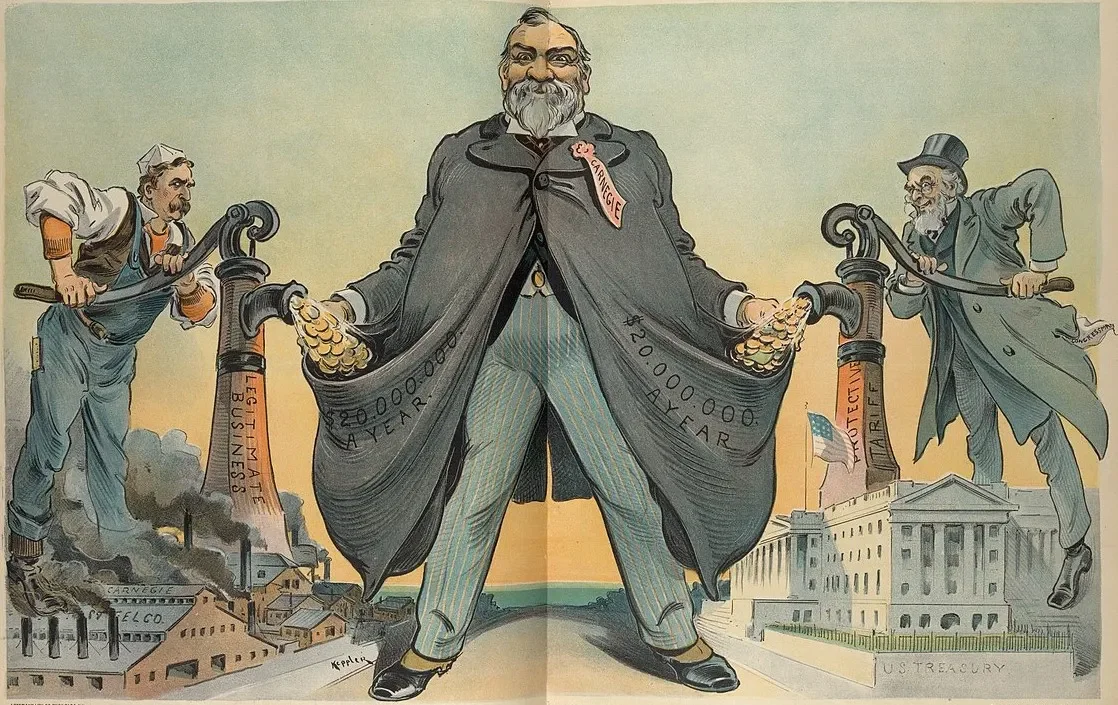
Cartoon of Andrew Carnegie, 1900. (Udo J. Keppler / Library of Congress via Wikimedia Commons)
This already tenuous situation worsens when one considers how racism and capitalism are intertwined. Capitalism does not breed financial inequality in a vacuum, rather it feeds off and deepens social inequalities. America’s history of racialized slavery was rooted in economic relations; slavery is the ultimate objectification and dehumanization of laborers. Global capitalism emerged within and profited from a context of white supremacy, a marriage of mutual racial-economic exploitation, which Cedric Robinson called “racial capitalism.”7 This history of interlocking oppression continued through the Jim Crow era and still haunts America today. Reflecting on Robinson’s work, Jodi Melamed argues, “Capital can only be capital when it is accumulating, and it can only accumulate by producing and moving through relations of severe inequality among human groups.”8 In other words, those at the top of the economic hierarchy rely on inequality to extract maximum value from those at the bottom. Thus, it should not be a surprise when wealthy white elites attempt to stoke racial hatred by blaming economic struggles on people of color. Dividing working-class people along racial lines masks the reality that a poor white person has much more in common with an immigrant working for less than minimum wage than they do with a white CEO. Scapegoating poor people of color directs attention away from the real power players and prevents the working class from cultivating mass solidarity. America’s continued legacy of racist policies, its history of overt attacks on Black businesses, and its failure to enact substantive reparations have all led to vast inequalities between Black and white communities. The median net worth (assets minus debt) of white families in the United States is about ten times higher than that of Black families.9 Furthermore, capitalism subsumed and monetized already-existing gender divides in labor. Women today still perform a disproportionate amount of unpaid “domestic” labor while also receiving lower wages in the labor market. Black women, for example, earn about 61 cents for every dollar white men earn.10 History shows that there has never been pure “free market” capitalism; rather, capitalism has, from the outset, fortified and capitalized upon existing racist and sexist hierarchies.
In short, capitalism and its beneficiaries have a vested interest in maintaining social and economic inequalities. Churches, of course, have made countless efforts to address these inequalities through charitable efforts. However, despite the considerable wealth of some American churches and their partners, faith-based charities often fail to bring about lasting transformation. While many churches offer valuable programs to meet the short-term needs of marginalized people, the Church’s patchwork of reactionary services merely funnels people back into the system that failed them in the first place. Change must come about on a systemic level, beginning at the roots of wealth creation and extraction: the workplace.
It is imperative to highlight that the devastation wrought by capitalism is neither an aberration, an accident, nor the result of individual failures; rather, capitalism is built on the logic of extraction. It is built to take “necessities from the masses to give luxuries to the classes,” as Martin Luther King, Jr. observed.11 According to economist Richard Wolff, capitalism is not merely about free markets and private property. Rather, the defining characteristic of capitalism lies in its organization of production, namely a distinction between the laborers who create surplus value (profits) and the capitalists who redirect that value.12 Capitalists maximize their profits by extracting value out of their workers. The decision makers at the top are motivated by incentive structures that have little to do with workers’ concerns or well-being. In other words, capitalism is defined by inequitable power differentials, beginning with value extraction in the workplace.
Capitalism maintains its hegemony by disconnecting workers from profit-distribution mechanisms. With little decision-making power, workers are left to the whims of the market, selling their labor as one of many production costs. Marx and Engels recognized this fact more than 170 years ago: “These workers, forced to sell themselves piecemeal, are a commodity like every other article of commerce, and are consequently exposed to all the vicissitudes of competition, and all the fluctuations of the market.”13 Their characterization holds up today, as hard-won worker protections are stripped away by neoliberal attacks on unions and government equity programs. Neoliberalism, the dominant mode of capitalism since the late 1970s, is an ideological and organizational shift towards privatization, deregulation, and “free” markets. Though cloaked in the language of democracy and freedom, the primary freedom that neoliberalism offers is the freedom for elites to amass wealth by extracting surplus value from their workers. It is a freedom for businesses and the people who control them—a freedom from worker considerations, environmental care, and equitable wealth distribution. As wealth and power expand at the top, economic risks shift to the bottom. This contrast became blatantly clear during the COVID-19 pandemic. Millions of workers lost their jobs, and low-wage “essential workers” risked their health to make ends meet. Meanwhile, American billionaires saw their wealth grow by a total of $845 billion (a 29 percent increase) in the first six months of the pandemic.14 This profit margin, built on the backs of essential workers, is about three times greater than the total value of all direct-payment stimulus checks provided by the CARES Act. According to neoliberal capitalist logic, labor is one production cost among many, thus there is no such thing as an essential worker. Their work is essential; as a collective they are necessary, but any worker can be exchanged for another, a replaceable part in the capitalist machine.
These observations suggest that workers and employers, more often than not, have fundamentally different goals. For most people, reasons for engaging in the economy are manifold: making a living, helping the community, sustaining the earth, even cultivating a sense of well-being.15 However, corporations and the elites who control them typically engage in the economy with one goal in mind: profit maximization. Milton Friedman, arguably the most popular economist of the 20th century, claimed that the only social responsibility of a business is to increase its profits. Corporate executives, Friedman argues, must respond only to their own bosses, the stockholders. Businesses that use their money for any purpose beyond profit maximization are not merely mismanaging their funds, they are “undermining the basis of a free society.”16 For Friedman and his neoliberal disciples, economic freedom is a democracy of the dollar: those with the most money call the shots.
The singular pursuit of profit precludes worker concerns and environmental sustainability. Paying workers at a rate commensurate with the value of their labor is antithetical to profit maximization. The earth, like workers themselves, also morphs into another source of economic extraction, valuable not in itself but for the resources it provides. Few individuals have such a myopic view of the natural order, yet extractivist capitalism knows no other way. Like a snake swallowing its own tail, international corporations—a small handful of which contribute to the majority of greenhouse gas emissions—consume the very means of their precious profit margins.17 Even as climate change threatens agricultural production and human and animal habitations, decision makers at the top remain largely unfazed because they bear almost none of these risks. Though climate change has already disturbed some corporations’ bottom lines, many more continue to benefit from the exploitation of the earth. This exploitation will continue as long as economic power is concentrated among those who can afford not to care. An alternative model will harness power among those most directly impacted by ecological and economic devastation. When the concerns of working people and care for our shared home take center stage, it becomes clear that the present economic order rests on an idolatrous value system.
1 For pragmatic purposes, this essay will be contextualized in the United States, though economic globalization and climate change are reminders that economic actions in one locale necessarily impact the well-being of people across the globe. Additionally, references to “the Church” or “the American Church” throughout this essay refer to the collective of self-professing Christians in the United States, including individual Christians but more frequently referring to institutional churches. This group is far from homogenous, so specific denominations or ecclesiological streams will be highlighted when appropriate.
2 Rob Wile, “The Richest 10% of Americans Now Own 84% of All Stocks,” Money.com, December 19, 2017. https://money.com/stock-ownership-10-percent-richest/.
3 Lydia Saad, “What Percentage of Americans Owns Stock?” Gallup.com, June 4, 2020, https://news.gallup.com/poll/266807/percentage-americans-owns-stock.aspx.
4 From 1948 to 1979, hourly wages increased at a nearly identical rate to productivity, meaning workers took home a consistent rate of the revenues they created. From 1979 to 2017 (a period marked by a significant decline in union representation), however, productivity grew about six times faster than worker compensation. [Elise Gould, “Decades of rising economic inequality in the U.S.: Testimony before the U.S. House of Representatives Ways and Means Committee,” Economic Policy Institute, March 27, 2019, https://www.epi.org/publication/decades-of-rising economic-inequality-in-the-u-s-testimony-before-the-u-s-house-of-representatives-ways-and-means-committee/.]
5 10.5 percent of all American households and 13.6 percent of American households with children experienced food insecurity at some point in 2019. Food insecurity, as defined by the USDA: “At times during the year, these households were uncertain of having, or unable to acquire, enough food to meet the needs of all their members because they had insufficient money or other resources for food.” [“Food Security in the U.S.,” Economic Research Service, United States Department of Agriculture, September 09, 2020, https://www.ers.usda.gov/topics/ food-nutrition-assistance/food-security-in-the-us/key-statistics-graphics.aspx#trends.]
6 Traci McMillan, “The New Face of Hunger,” National Geographic Magazine, accessed October 1, 2020, https://www.nationalgeographic.com/foodfeatures/hunger/.
7 Robin D.G. Kelley, “What Did Cedric Robinson Mean by Racial Capitalism?” Boston Review, January 12, 2017, http://bostonreview.net/race/robin-d-g-kelley-what-did-cedric-robinson-mean-racial-capitalism.
8 Jodi Melamed, “Racial Capitalism,” Critical Ethnic Studies 1, no. 1 (Spring 2015): 77.
9 Lisa Dettling, et al., “Recent Trends in Wealth-Holding by Race and Ethnicity: Evidence from the Survey of Consumer Finances,” The Federal Reserve, September 27, 2017, https://www.federalreserve.gov/econres/notes/feds notes/recent-trends-in-wealth-holding-by-race-and-ethnicity-evidence-from-the-survey-of-consumer-finances-20170927.htm
10 Data from 2017: “Earnings,” United States Department of Labor Women’s Bureau, accessed October 4, 2020, https://www.dol.gov/agencies/wb/data/earnings.
11 Martin Luther King Jr., The Autobiography of Martin Luther King, Jr., ed. Clayborne Carson (New York: Warner Books, 1998), 36.
12 Richard Wolff, Democracy at Work: A Cure for Capitalism (Chicago, IL: Haymarket, 2012), 21-22. By this definition, communist states like China and the USSR are also examples of capitalism. Their mode of “state capitalism” still separates workers from surplus-distribution mechanisms; the primary difference is that workers are employed by the state rather than private individuals. Workplace democracy is absent in both cases. [Wolff, 80-82.]
13 Karl Marx and Frederick Engels, “The Manifesto of the Communist Party,” in The Communist Manifesto and Other Revolutionary Writings: Marx, Marat, Paine, Mao, Gandhi, and Others, ed. Bob Blaisdell (Mineola, NY: Dover Publications, 2003), 130-131.
14 Saloni Sardana, “US billionaires’ wealth grew by $845 billion during the first six months of the pandemic,” Business Insider, September, 17, 2020, https://markets.businessinsider.com/news/stocks/us-billionaires-wealth net-worth-pandemic-covid-billion-2020-9-1029599756.
15 It must be noted that, while many of these goals may be pursued at the individual level by amending consumption habits, the primary concern here is the role of labor, not consumers. People are, for the most part, free to “vote with their dollar” in the marketplace. However, individuals as laborers typically have no such voice in their workplace, let alone in the wider economy. Moreover, individual consumers, particularly working-class individuals, have little power to affect economic change. Workers in collective solidarity, on the other hand, have the potential to make change that individual consumers could never bring about.
16 Milton Friedman, “A Friedman doctrine‐- The Social Responsibility Of Business Is to Increase Its Profits,” The New York Times, September 13, 1970, https://www.nytimes.com/1970/09/13/archives/a-friedman-doctrine-the social-responsibility-of-business-is-to.html.
17 There is a growing trend called eco-capitalism (or green capitalism) that suggests: 1) ecological concerns can be solved through market mechanisms; 2) businesses should be concerned about the long-run financial impacts of environmental degradation. These approaches fail to resolve the core problem: that capitalism’s commodification of the natural world will always lead to ecological exploitation. Nearsighted profit goals will almost always take precedence in an extractivist, profit-driven economy. The system that created climate change cannot be expected to fix it.