
What Did You Do for a Living, Mary?
Charlotte Jacobs
December 20, 2025
These reflections are from the upcoming article Charlotte Jacobs, “The Silencing of Mary: Labor as the Intersection of Everything,” in Queering Theology: Transformative Perspektiven und Praxis queerender Theologien, ed. Charlotte Jacobs, Sonja Thomaier, and Joerg Rieger (Göttingen: VR unipress, 2026).
“How silently, how silently, the wondrous gift is given...” With these words, the birth of Jesus is sung anew every year in the well-known English Christmas carol Oh little town of Bethlehem (1868). “No ear may hear his coming” the hymn continues a few verses later. Hardly any other event is as present and at the same time as invisible as the birth of Jesus Christ, as it is embedded in the faith of Christianity and commemorated with great ceremony every year. You don't need to have experienced or witnessed a birth to know: Something is missing. For people giving birth, this obvious invisibility can even seem grotesque. Where is the blood, the sweat and the cries of labor pain?
(The following image contains a graphic depiction of Mary birthing Jesus.)
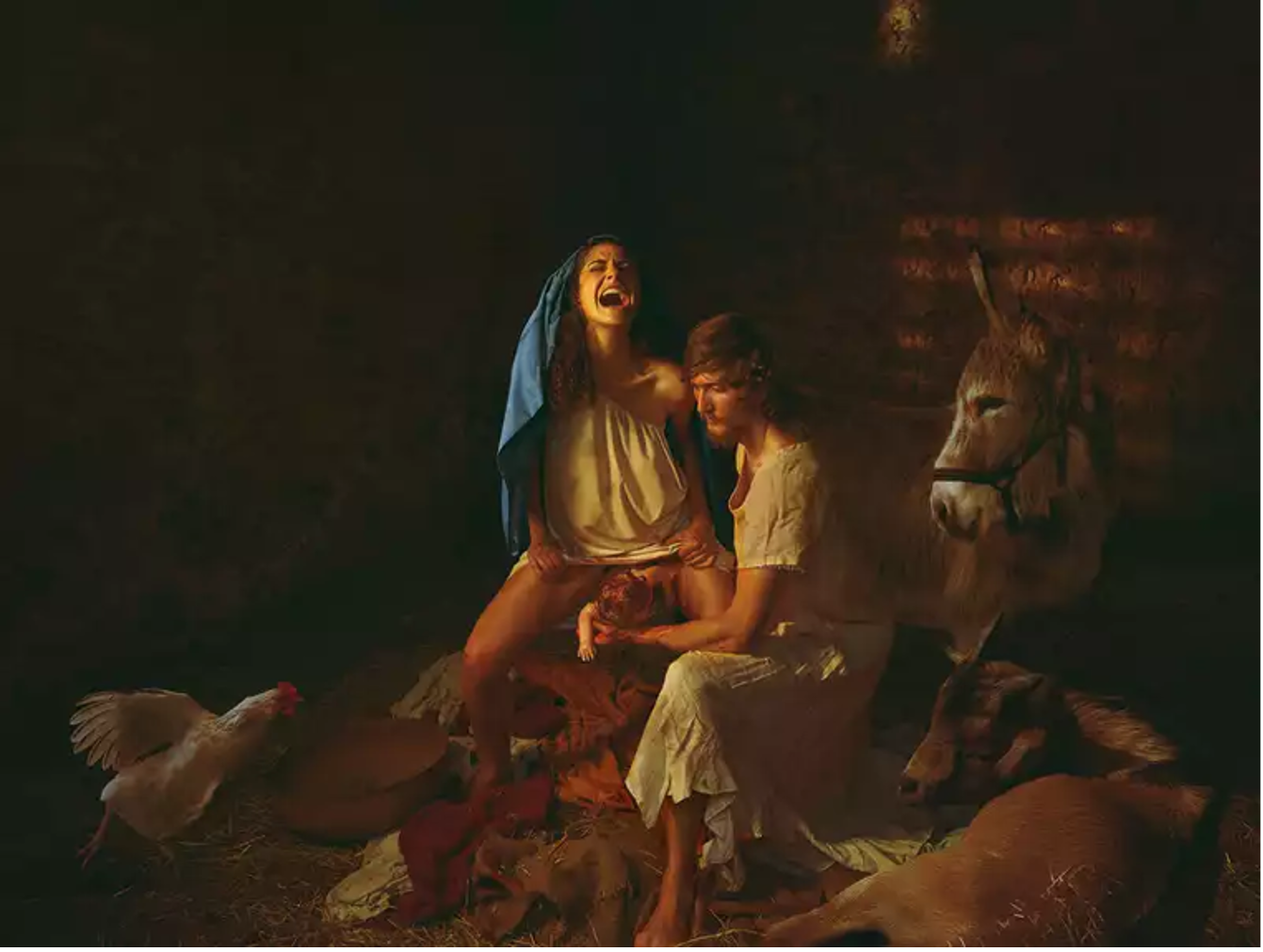
Natalie Lennard, The Creation of Man (2017) Giclee on Hahnemuhle Pearl Paper, 150 x 190cm.
In her work The Creation of Man (2017), British artist Natalie Lennard has impressively filled this empty space with a sight that is both familiar and unfamiliar. The scenario of the stable in Bethlehem with Mary, Joseph, baby Jesus, and the donkey—a familiar scene in Christian dominance culture not only to Christians—breaks with our viewing habits in a peculiar way. For the first time, a vaginal birth is also in the picture. In a squatting birthing position, Mary pushes out the infant Jesus. Jesus' head and shoulders can be seen, bloodstained and sticky. Mary's face is pained yet she is screaming powerfully. With this composition, the artist shows us the irony of singing about such an event in the words of Silent Night, Holy Night (1818) and breaks through the visual convention of passive chastity of the Virgin Mary, allowing us, in all shamelessness, to—literally—look under her skirt.
Yet the artist reveals far more than a mere narrative gap in the Nativity story. What is depicted is not only the reduction of Jesus’ birth, but also the broader cultural invisibility of Mary’s labor. In this light, a particular linguistic nuance becomes especially telling: As a German feminist theologian, I appreciate the English term labor for its semantic advantage over many other languages. The phrase to go into labor inherently acknowledges the physically demanding activity of childbirth as a form of labor – a visualization that is often absent in other languages. And yet, at the same time we’re left wondering: What did Mary do besides her labor as a caregiver, what about her livelihood? What did Mary do for a living?
Why is it that we don’t know—unlike with other disciples—what Mary’s profession was? And why have we never even thought to ask? Over the centuries, through layers of interpretation and theological retelling, the historical Jewish Woman of Color from the poorer strata of Roman-occupied Galilee was transformed into something entirely different: a white, chaste, noblewoman at the center of an imperial religion. She is presented to us every year as a full-time mother and homemaker. Except, historically, that simply wasn’t a thing.
The idea of women as full-time mothers and housewives is a bourgeois projection, one that doesn’t match historical reality. From historical research—and even from the biblical tradition itself—we know that women worked, of course they did; they had to in order to survive. Often, they practiced the same trade as their husbands—just think of the apostle Prisca, a tentmaker, who worked side by side with Aquila and Paul in the craft (Acts 18:3).
And what about Mary? We will likely never know what kind of work she did. But we can say with certainty that she did work for pay. And in this silence, a gap in our collective memory opens and we might ask ourselves: if her husband Joseph was a carpenter, and her son Jesus was a carpenter (Mk 6:3; Mt 13:55) – what might she have been doing all day long? Given our deeply internalized images of Mary, it is genuinely difficult to picture her as a muscular, hands-on (day-)laborer or as Mary the Carpenter. We have long internalized the bourgeois division of labor structured along binary gender lines, which manifests in ideal-typical forms of racialized femininity and masculinity.
But maybe this year, as Christmas comes around, inspired by Natalie Lennard’s work, we begin wresting the symbolic images out of the grip of those in power—images that have long been used to legitimize, enforce, and conceal domination. By re-centering the figure of Mary as a laboring Jewish Woman of Color, of low social standing in rural Galilee—into whose mouth the gospel of Luke places the revolutionary words “He has brought down the powerful from their thrones and lifted up the lowly” (Luke 1:52)—we might actively resist the theological move that seeks to turn her into a tool of mystification of ruling class white femininity and the construction of unified and naturalized womanhood.
One final look back at Natalie Lennard’s photograph: On closer inspection, Joseph might also appear in a different light. In Lennard’s composition he is a secondary figure—his vacant gaze giving the impression of absent-mindedness. And yet, he is not merely a passive observer of the birth, as in classical depictions but an active participant: a birth attendant, a midwife. In this way, the image queers conventional notions of modern masculinity and (the lack of) care that are usually projected back onto Joseph. For this reason, the possibility of doubt arises, where Joseph—already held up as a role model of social fatherhood for accepting Jesus as his son without biological paternity—could gain another dimension. Perhaps the Nativity, which within the Christian tradition announces the reversal of relations and a radical inversion of hierarchies, also heralds a different kind of labor relations and mutual care. The working couple Mary the Carpenter and Joseph the Midwife certainly remind us of a messy solidarity in a common struggle.
Charlotte Jacobs is a Protestant theologian from Germany, doctoral candidate at the University of Jena, and scholarship holder at the Rosa Luxemburg Foundation. In her dissertation, she examines the relevance of class analysis for contemporary Protestant theology and ethics.