
The Erasure of Labor in Contemporary Visions of Elefsina
November 15, 2026
Michelle Harvey
Every year, spiritual seekers travel to Elefsina in search of the legacy of the ancient Eleusinian Mysteries. Many hope the site’s association with mystical experience offers wisdom for addressing today’s social and ecological crises. Yet an exclusive focus on the Mysteries obscures another, often overlooked history of Elefsina: its role as a center of industrial labor, environmental struggle, and collective action. If we are looking to Elefsina for resources to imagine a better future, that history may have as much to teach us as the ancient rites themselves.

source: https://openeleusis.eu/node/29
Ancient History
Elefsina (ancient Eleusis) has been inhabited since the Middle Helladic period (c. 2000–1580 BCE) due to its fertile land, coastal access, and defensible location. During the Classical and Hellenistic periods, Eleusis transformed from a local sanctuary into an integral site in the Athenian religious calendar, hosting a yearly initiation ceremony known as the Eleusinian Mysteries. The whole population of Athens was said to travel the Sacred Way from Athens to Eleusis for the Mysteries. Although the ceremony itself remains largely unknown, historical records suggest participants drank kykeon after fasting, and some scholars have argued that the beverage may have contained psychoactive compounds.
Yet the Mysteries were never simply a private spiritual experience. They also played an important political role in representing Athens’ claim to pan-Hellenic leadership. Through the aparchai (first fruits), communities across the Greek world contributed a portion of their harvest to Demeter’s sanctuary at Eleusis, while Athens used the prestige of the Mysteries to reinforce its regional authority. From the beginning, then, Eleusis was embedded within wider social, economic, and political networks rather than standing apart from them.
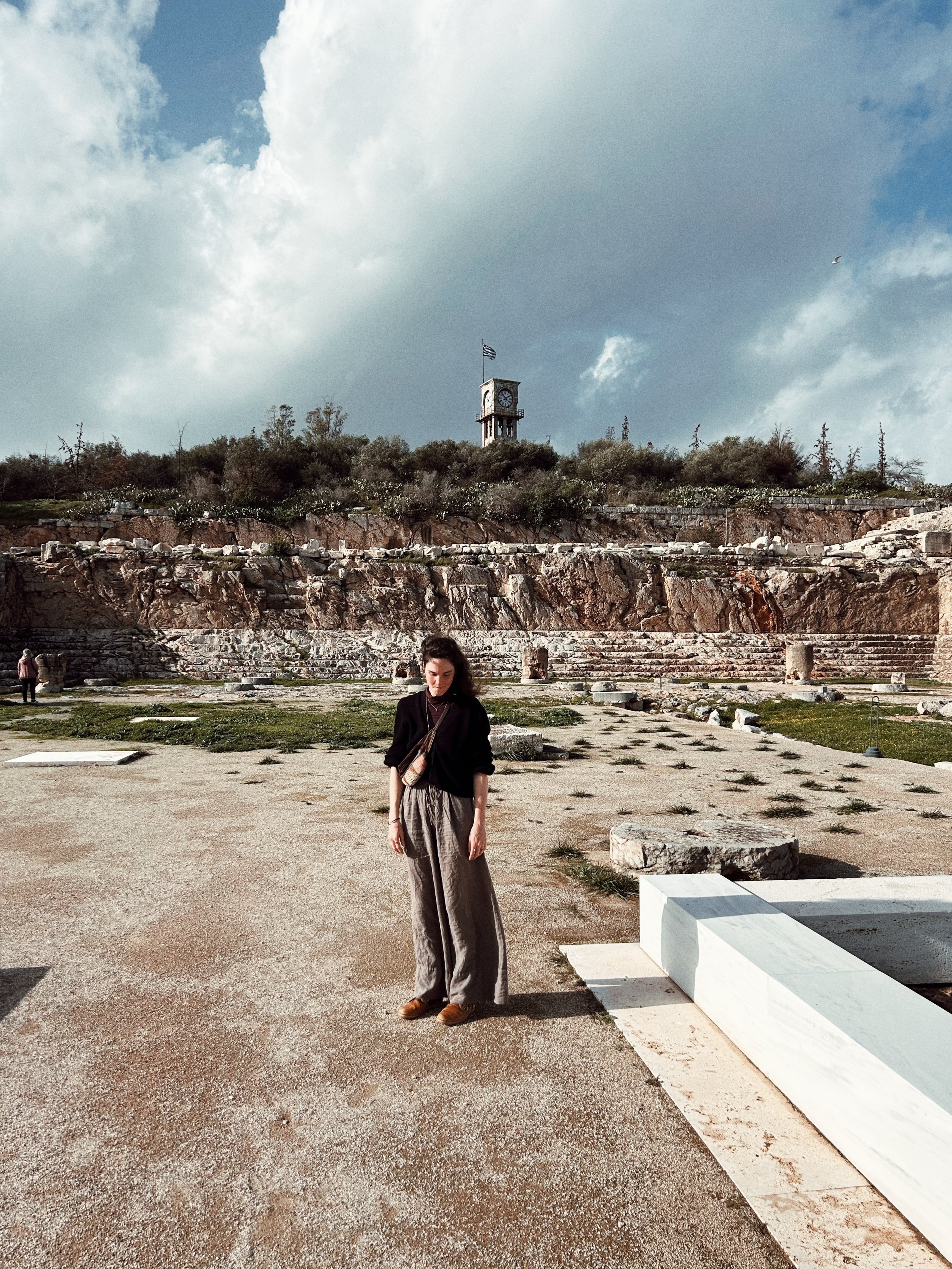
In 2023, Elefsina was named European Capital of Culture and became the home of the New Eleusis Symposium, which seeks to reimagine ancient wisdom for contemporary challenges. In a place with such a long and well-documented history, however, it is worth asking which past is being revived, which histories are being overlooked, and whether those choices serve the symposium’s stated goals of addressing global challenges and protecting life on our planet. In practice, both the symposium and many contemporary spiritual seekers have centered the Eleusinian Mysteries, particularly their association with transformative mystical experience.
source: michelle harvey
This emphasis reflects a common belief within alternative spirituality: that changing consciousness can change society. The 2025 symposium slogan, “how to change your mind to change the world,” captures this perspective. Yet this way of understanding spiritual transformation owes more to nineteenth- and twentieth-century theories of religious experience, later developed through transpersonal psychology and psychedelic culture, than it does to the ancient world. Although participants in the Mysteries undoubtedly had personal experiences, those experiences were embedded within the social, political, and religious world of ancient Greece. The question, therefore, is not simply whether contemporary interpretations are historically anachronistic, but whether mystical experience alone can generate the social and ecological transformations many seek.
Another history of Elefsina suggests a different answer.
While internationally known for the Mysteries, Elefsina is equally remembered in Greece as a center of industry, environmental degradation, and labor struggle. Beginning in the late nineteenth century, factories, refineries, and cement works transformed the town. Industrial growth brought employment and economic development, but it also produced pollution, occupational disease, and severe environmental damage. By the late twentieth century, residents described Elefsina as “the city with shut windows,” a reference to the dust, fumes, and odors that saturated everyday life.
Alongside industrialization emerged a powerful labor movement. Founded in 1900, the Builders Guild was one of many organizations created in response to dangerous working conditions and worker exploitation. Labor mobilizations in Elefsina became landmarks in Greek labor history, most notably the 1929 strike at the Kronos factory, which grew into a town-wide uprising and demonstrated how workers’ struggles could become broader community movements. In this history of solidarity, collective action, and environmental struggle, Elefsina offers another model for confronting contemporary crises, one grounded not in individual transformation but in organized social change.
Contemporary Spiritual Praxis
In the case of Elefsina, the spiritual weight of the Mysteries overshadows later histories. However, these histories are where we find examples of deep solidarity, community organising, and collective action. Through this industrial history, we also see the capitalist impetus to exploit the land, sea and people, the consequences of which are dire and ongoing. Ancient and contemporary Elefsina share a common thread: both are entangled in a wider economic and political web—in the case of ancient Eleusis, the web of Athenian poliadic ideology; from the 19th Century onwards, industrialisation driven by capitalism and broader geopolitical changes affecting the Greek economy.
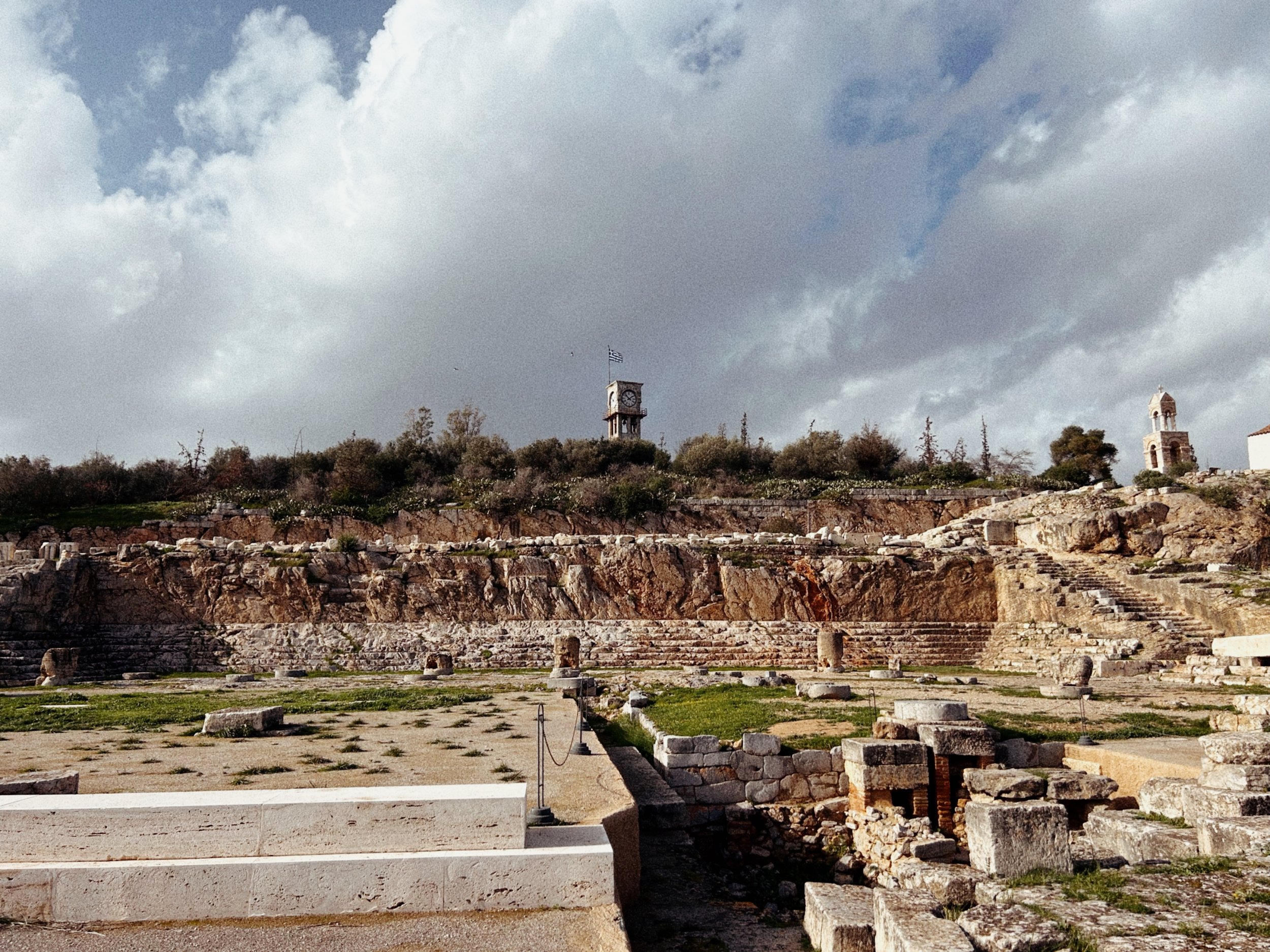
If we are to use Elefsina as grounds for spiritual teaching in service to “tackling modern global challenges and to the protection of life on our planet” (the stated goal of the symposium), expanding reach to Elefsina’s overlooked workers’ history would be a more effective place to begin asking questions and finding solutions that have already been well underway since the early 20th Century. The tendency to locate the spiritual in the realm of experience is especially prevalent in alternative spiritual movements, and the potential of a psychedelic ritual provides ample fodder for that project; however, tenuous this possibility might have been historically. However, as I have outlined here, even if the ritual did have a psychedelic component, the experience had by those in the ancient world cannot be likened to a contemporary one framed under the auspices of transpersonal psychology. Nor does this experience automatically lead to the changes we need to improve, protect, and nourish life in all its forms. Extracting something very specific from ancient religion, then extrapolating it through psychologised frameworks to filter out what is considered “religious baggage,” and finally re-presenting it as a de-politicised individual experience is commonplace in contemporary spirituality. By reweaving and re-grounding spiritual expression into its historical context, we can more easily identify how inappropriate this can be, while also uncovering other histories through which to re-imagine what spiritual work can be.
source: michelle harvey
If the protection of life is a spiritual commitment, then “spiritual experience” should extend itself out from abstract notions of “consciousness’ to the concrete conditions under which people work, breathe, and live. Spiritual work can then be reimagined as participating in struggles for safer workplaces, cleaner environments, and greater collective control over the conditions of everyday life. Elefsina’s workers’ history offers a starting point for spiritual praxis to be reimagined in this light because of the very clear contrast between what is being lived there and what international contemporary seekers wish to highlight. However, this site also acts as a microcosm for how this phenomenon is at play more widely and how that might be interrupted.
Michelle Harvey just completed her Master’s of Theological Studies at Vanderbilt Divinity School. She also holds a BA from Central Saint Martins College of Art and Design in London. Her academic focus is on new spirituality movements and the role that the academic study of religion has in shaping the practice, ethics and philosophy of these groups. As the “spiritual but not religious” category grows, she believes there’s a heightened responsibility to examine and contribute to the discourse on how these groups interact with the economy and the communities they inhabit.