
Queering Labor (Labor Day 2026)
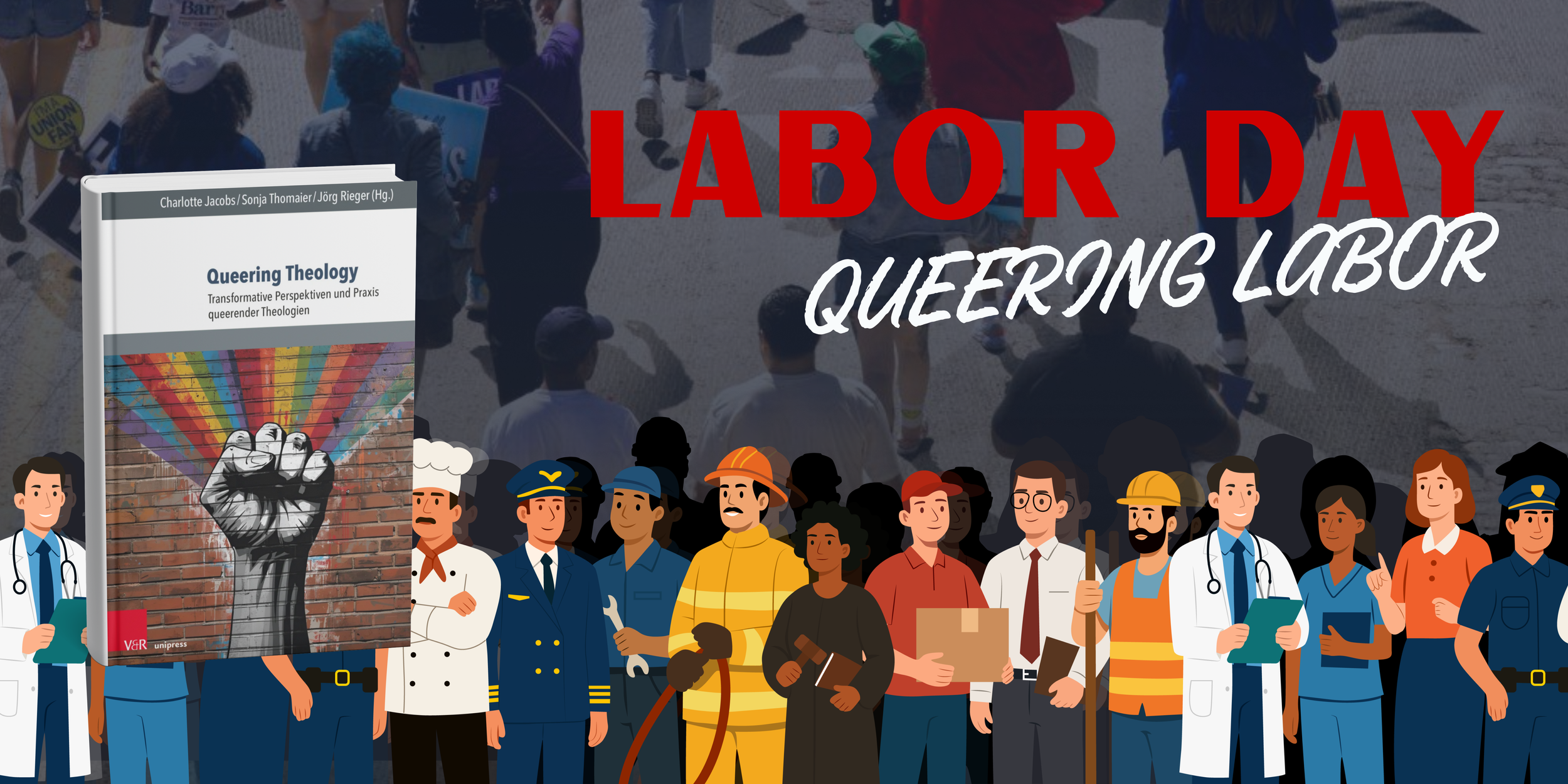
Labor Day is often marked by expressions of gratitude for work and workers. Yet it can also provide an opportunity for faith communities to ask deeper questions: Why is some labor valued more than other labor? Who benefits from the work of others? And how do our theological assumptions shape the ways we understand power, class, and economic life?
In this Labor Day contribution, Joerg Rieger challenges some of the most common assumptions about class in both academic and religious discourse. Rather than treating class as a matter of individual status, income, or social location, Rieger invites us to understand class as a relationship shaped by power, conflict, and interdependence. Such an approach, he argues, unsettles what is often taken as normal: the belief that individuals succeed or fail on their own, that economic inequality can be addressed apart from questions of power, or that churches can meaningfully engage economic justice without examining the structures that shape the lives of working people.
For pastors, faith leaders, and educators, this reflection offers a timely challenge. As many congregations gather on Labor Day weekend, the temptation is often to speak about work in purely personal or moral terms. Rieger asks us to look beyond individual attitudes and toward the relationships that organize economic life itself. In doing so, he opens new possibilities for thinking about solidarity, labor, and the theological significance of the struggles faced by those who work for a living.
Whether used as a resource for preaching, teaching, discussion groups, or personal reflection, this excerpt encourages us to examine how faith might help us see beyond what is considered normal and engage more honestly with the realities of labor, power, and economic justice. It is our hope that these reflections will spark conversations that continue well beyond Labor Day and contribute to the ongoing work of building communities grounded in dignity, solidarity, and shared flourishing.
The following is an excerpt from Rieger’s article in Queering Theology: Transformative perspectives and practice of queer theologies (open access PDF) released in June 2026.
Queering Class Analysis for Theologians
Class analysis can, therefore, be queer but is not necessarily so. Normal non-queer definitions of class, as taught in many schools and universities in the West today, focus on seemingly straightforward and quantifiable matters such as social status and income levels. Sociologists have fine-tuned this analysis over the years by distinguishing as much as 15 different classes. But the problematic aspects of such non-relational understandings of class, as taught in sociology classes and theology schools (when the issue comes up occasionally), should not be overlooked. Stratification theories presuppose that classes exist somehow like the layers of a cake that can be distinguished neatly, are independent of one another, so that each class can therefore also be studied in and of itself. Questions of power and power differentials are methodologically excluded from such theories, which mirrors the prevalent methodological exclusion of the study of power in theology and religious studies,1 a problem that queer theory is seeking to redress as well. Even the growing interest in so-called inequality studies, which in some cases are beginning to supplant stratification theories, is insufficient if class and labor relations are not considered.
The problematic term classism, which pops up even in theological discourse once in a while, demonstrates this lack of study of relationship and power as well. The term classism insinuates that the problem of class has to do with stereotypes rather than with relationships of extraction or exploitation. As a result, the use of the term tends to imply that the problem can be overcome by doing away with class stereotypes.2 This is often how class is addressed in theological approaches that seek to “celebrate diversity” or “hospitality” for others, and consider their mission accomplished when all are “seen” and “heard.” Some pastors, informed by these theologies, pride themselves on having overcome classism because millionaires and homeless people share the same pews in their churches.
Another problematic term that betrays an insufficient understanding of class and reduces its potential for queerness is the emphasis on the problem of consumerism, which is highlighted in many contemporary theological engagements with ecology.3 Typical references to the term tend to blame average consumers for consuming too much. In so doing, they ignore and thereby cover up and protect the normalcy of the capitalist engines that drive consumption. Whatever solutions to overconsumption are suggested here end up supporting the normalcy of capitalism because they lack deeper engagements of power differentials and asymmetrical class relationships, which are considered to be normal.
Leave a comment (on Substack)
Examples of academic studies of class that neglect the question of power and relationship between classes abound. In theology and religious studies, for instance, blue-collar religion is often investigated without consideration of how it shapes up in relation to the executive class, even though this is a vital aspect of working-class existence and accounts for some of its queer potential.4
Even when some scholars of theology and religion study workers and poverty, other classes are rarely studied. The middle class appears to be taken for granted as normal, and therefore seems to require little investigation. On the other end of the spectrum, the executive or ruling class disappears from academic study not only because it may be more difficult to get access to its operations (imagine what it would take to do a proper ethnography of the wealthy!) but perhaps also because its ways of exercising power are typically out of sight and therefore out of mind. The motto is usually “fighting poverty” and rarely “fighting wealth.” As a result, the middle class is the norm of what is considered normal, and it seems, therefore, also to be the norm for solutions. No wonder so much theology is focused on moral appeals to the middle class, which are ultimately bound to fail.
All this changes if these common notions of class, perceived as normal, are queered.5 When the study of class as relationships of power is introduced, the academic study of theology and religion can now consider factors that are currently not being addressed in the field. To be sure, queering conversations about class present their own challenges, as class relationships are, for the most part, conflictual, deeply wrought by power differentials and riddled with fault lines and struggles as capitalism builds its success on the exploitation of and extraction of profit from those who have to work for a living. Those who are bold enough to address such topics will experience pushback. Theologians who talk about class conflict are accused of embracing an “ontology of violence,” for instance, as if conflict only comes into existence when it is mentioned.6 In the social sciences, so-called conflict theories are often considered outdated, and from the perspective of what has been called deprivation theories, addressing class as a relationship seems to project workers in negative terms. Queering the notion of class needs to push beyond these efforts to normalize the topic.
The old accusation, another pillar of the normalcy of conventional class discourse, that those who address matters of class as contentious relationships are instigating class struggle seemingly never dies. It stems from non-queer definitions of class and power as status and stratification, which is considered normal, and finds a variety of expressions. Heteronormative and binary notions of gender and sexuality mirror the apparent normalcy of non-contentious stratification theories of class with the same result: By covering up the existing conflicts instigated by the dominant powers, they normalize the existing relations of gender and sexuality and thus support the dominant status quo, whether they realize it or not. Covering up contentious relations of gender and sexuality, which allows one gender and one sex to dominate all others with impunity (also observable in commonly held binary notions of race and ethnicity) further reinforces the tensions between the classes but is also at work within the classes themselves, weakening solidarity.
The widespread assumption that individualism is real, whether by those who favor it or those who oppose it, is perhaps the most substantial hurdle for discovering the queerness of class as contentious relationships. According to the tenets of individualism, people exist in isolation from one another and create their own successes or failures. Individualists celebrate what communitarians lament, but both assume that individualism is the new normal of modernity. An understanding of class as relationship introduces some queerness into these assumptions and challenges them. The truth is that people are always already connected in many ways, whether they know it or not. Individualism is, therefore, not a harmless conceptual misunderstanding but covers up relations of power. More specifically, individualism is the ideology of the elites who seek to cover up the fact that they are more connected than anyone else, as their power and wealth are produced by the many. As a result, individualism covers up the normalcy of what might be called “class struggle from the top.” The working majority accepts the apparent normalcy of individualism to its detriment, and academic work that builds on it, whether to support or critique it at face value, is flawed from the outset.
The assumption that relational class analysis does not apply to the United States because of class mobility is another assumption of normalcy that cuts against the queerness of class. A prominent US feminist scholar of Buddhism once told me that she never considered class a matter of concern because it was the only thing she could change about herself. Although class mobility in the United States is lower than that of most developed countries, ranking behind Lithuania according to the 2020 World Economic Forum report, the American Dream still defines what is considered normal.7And even if people intuitively know that they may not be able to improve their class position short of winning the lottery, they maintain the hope of normalcy because they believe that their children and grandchildren will be socially mobile. To varying degrees, this dream has also attached itself to the promises of various forms of identity politics, pulling them into the realm of the normal. As identity groups in the United States are struggling for liberation and empowerment, there is an unspoken assumption that their group is next in line to attain the American Dream. Yet even if some women and some racial and sexual or gender minorities have assumed positions of leadership in the economy, politics, or religion, this does not mark a new normal, as it does not mean that the American Dream is now achievable for all.
Leave a comment (on Substack)
A major challenge that contributes to maintaining the normalcy of conventional class analysis in the academy is that the label of “Marxism” gets attached to relational definitions of class that reflect on the tensions between classes. Yet while it seems inconceivable to many academics that anyone would be able to come up with an understanding of class struggle based on their own experience, this is exactly what happens to working people when they take an honest look at their employment in the current economic climate. The ultimate root for the queering of class analysis, therefore, is not Marxism but people’s experience of class tensions every day. Common problems like wage depression, loss of benefits, or lack of voice and power at work are part of the capitalist normal that begs to be queered.
In addition to experiencing class struggle in real time, reflecting on the relational and exploitative character of classes is not a passing fad, as Greek, Roman, and medieval philosophers were already aware of tense class relations, as were the Hebrew prophets (although Greek and Roman philosophers usually took the side of the ruling classes while the Hebrew prophets sided with working people). This is not to say that class in ancient times would be identical with class under the conditions of capitalism; the point is merely that class has been analyzed as a relational matter in any time period, with an eye towards power differentials and the potential of queering the dominant status quo of each age.
This is the broader horizon of our suggestion of queering labor as ultimate concern, and this is where the study of theology and religion might find new insight that might be a game-changer.
Joerg Rieger is Distinguished Professor of Theology and the Cal Turner Chancellor’s Chair of Wesleyan Studies at Vanderbilt University and Divinity School. He is also the founding director of the Wendland-Cook Program in Religion and Justice at Vanderbilt Divinity School.
For more than three decades he has worked to bring together theology and the struggles for justice and liberation that mark our age. His work addresses the relation of theology and public life, reflecting on the misuse of power in religion, politics, and economics. His main interest is in developments and movements that bring about change and in the positive contributions of religion and theology. His constructive work in theology draws on a wide range of historical and contemporary traditions, with a concern for manifestations of the divine in the pressures of everyday life.
Author and editor of 27 books and over 200 academic articles, his books include Theology in the Capitalocene (2022), Jesus vs. Caesar: For People Tired of Serving the Wrong God (2018), Unified We are a Force: How Faith and Labor Can Overcome America’s Inequalities (with Rosemarie Henkel-Rieger, 2016), Occupy Religion: Theology of the Multitude (with Kwok Pui-lan, 2012), No Rising Tide: Theology, Economics, and the Future (2009), and Christ and Empire: From Paul to Postcolonial Times (2007). His books have been translated into Portuguese, Spanish, Italian, German, Korean, and Chinese.
1 For a critique of the study of religion and theology along these lines, see Talal Asad’s Genealogies of Religion: Discipline and Reasons of Power in Christianity and Islam (1993).
2 This is not to say that an awareness of stereotypes and how they are produced does not have merit, but it is misleading to think that stereotypes themselves constitute class exploitation.
3 See, for instance, McFague 2000.
4 Sean McCloud (2007) explicitly rejects “deprivation theories” of class without letting on that there might be other ways of discussing class as relationship.
5 For earlier theoretical efforts to queer the notion of class, see the essays in Gibson-Graham/Resnick (Wolff 2001, emphasizing fluid and uncentered understandings of class identity over against capitalist totality, and providing new and creative means of resistance. See also the postmodern reading of class offered by Stephen A. Resnick and Richard D. Wolff in Knowledge and Class: A Marxian Critique of Political Economy (1989).
6 Milbank 2006.
7 The Global Social Mobility Report 2020.